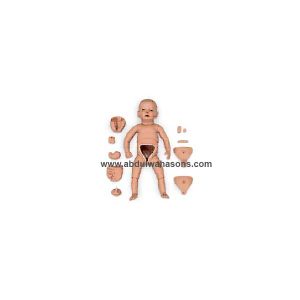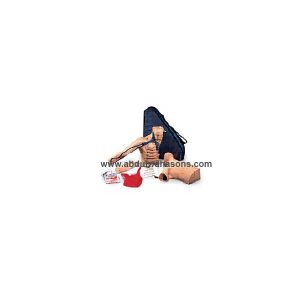
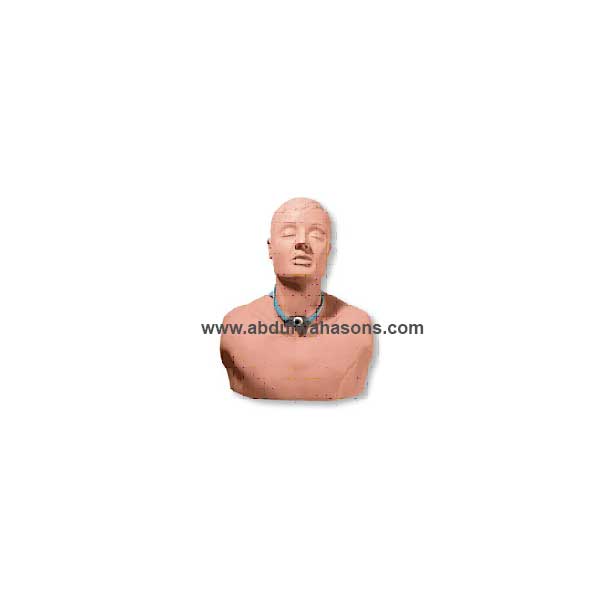
Adult Patient Education Tracheostomy Care Manikin
Product Description
- Adult Manikin
• Dressing Changes
• Cuff Inflation
• SuctioningIdeal for teaching patients and caregivers the skills they will need to perform at home. Includes oral and nasal passages, the pharynx, epiglottis, trachea, esophagus, tracheostomy site, and cricoid cartilage. The mouth and jaw are flexible to allow oral suctioning. The trachea branches into the left and right bronchial trees. Students can practice suctioning techniques, proper cuff inflation, dressing changes, and other techniques. Cleansing and maintenance of the external tracheal site can be performed just as on an actual patient. The adult manikin comes with one tracheostomy tube, instruction guide, and hard carry case.
Related products
-
Code Simulator 12-Lead Arrhythmia Simulator – ZOLL
Pace and defibrillate directly into this interactive 12-lead ECG simulator through your hands-free defibrillation cable. Connects directly to monitor • Does not work with manikin • Simulate electrical capture with your external pacer. Press simulator capture key to select one of four preset pacing capture levels: 70, 80, 90, or 100mA. When pacer current is greater than selected capture level, paced beats appear on your monitor. Waveforms for pacing include: Sinus Brady (two), 1st degree A-V block, 2nd degree type I A-V block, 2nd degree type II A-V block, 2nd degree type II A-V block with PVCs, and 3rd degree A-V block. • Simulate cardioversion with your manual, semi-automatic, or automatic defibrillator. Activate “convert” feature to select - before defib discharge - another rhythm to run immediately after defib discharge. Waveforms for defibrillator training include: V. Fib., V. Tach (high rate), V. Tach (low rate), Torsade, A. Fib, A. Flutter, PSVT, Sinus Tach, Sinus Rhythm, Sinus Rhythm with PVCs, Asystole, and NSR. • Generate realistic 12-lead ECG rhythms. Connect your ECG cable to simulator’s 10 ECG snaps. Independent chest lead and limb lead ECG signals create realistic 12-lead ECGs for each rhythm. Generate ST segment and T wave abnormalities including: Anterior MI, Inferior MI, Antero-Septal ST Elevation, Anterior ST Depression, Lateral ST Elevation, and Inferior ST Elevation. • LED indicators: pacer pulse detection, defib discharge detection, and low battery.
-
Advanced Venipuncture and Injection Arm – Light
Product Description
This revolutionary training arm provides complete venous access for IV therapy and phlebotomy, plus sites for intramuscular and intradermal injections. An extensive 8-line vascular system allows students to practice venipuncture at all primary and secondary locations, including starting IVs and introducing Over the Needle IV Catheters. The venous system simplifies setup with only one external fluid bag supplying artificial blood to all veins simultaneously. The dorsal surface of the hand includes injectable metacarpal, digital, and thumb veins. The antecubital fossa includes the median cephalic, median basilic, and median cubital veins. Venipuncture can also be performed along the basilic, cephalic, accessory cephalic, and median antebrachial veins. Intramuscular injections may be performed in the deltoid muscle and intradermal injection sites are located in the upper arm. Intramuscular injections into the deltoid muscle are enhanced by the soft, lifelike skin and by the natural bony landmarks in the region. Intradermal injections using distilled water will create characteristic skin welts at designated sites on the upper arm. The realism of the Life/form® Advanced Venipuncture and Injection Arm is truly amazing. The soft, flexible fingers are molded separately with extreme attention paid to every detail – right down to the fingerprints! Flexion of the wrist helps students develop manipulation skills. The replaceable skin rolls as the veins are palpated, and a discernable “pop” is felt when entering the veins. The Life/form® molding process reproduces the fine details of the skin to make the arm look and feel alive. Valves in the veins can be seen and palpated on the skin surface. Simulated veins and skin are completely replaceable to keep this training arm looking and working like new. Under normal use, hundreds of injections may be performed before the veins or skin need to be replaced. Complete replacement kits are available and easy to use. To extend the life of the veins, an aerosol sealant is available to seal punctures and prevent leakage.
Complete Venous Access:
• Basilic V.
• Cephalic V.
• Digital V.
• Dorsal Metacarpal V.
• Median Basilic V.
• Accessory Cephalic V.
• Extensive Venipuncture System
• Flexible Fingers and Wrist
• Intradermal Injections
• Intramuscular Injections
• Median Antebrachial V.
• Median Cephalic V.
• Median Cubital V.
• Replaceable Skin and Veins -
Pediatric Lumbar Puncture Simulator
Product Description
Infants commonly require lumbar puncture as a diagnostic procedure used to collect a sample of cerebrospinal fluid (CSF), measure cerebrospinal fluid pressure, or to inject medications intrathecally. The Life/form® Pediatric Lumbar Puncture Simulator represents a 10-12 month old infant placed in a left lateral decubitus position with the neck and knees flexed, approximating the necessary fetal position. The embedded iliac crest offers exceptional realism, while the removable spine, spinal canal and skin pad make training simple and hassle free. Lumbar puncture may be performed in the L3-L4, L4-L5, or L5-S1 spaces. The correct site can be located by palpating the iliac crest and spine. A small “give” will be felt as the spinal needle is advanced slowly into the proper space. Fluid will flow when the needle is in proper position. Students will appreciate the opportunity to practice this delicate but commonly performed procedure on a simulator that is both appealing and anatomically accurate.
Benefits:
• Targets key skills specific to pediatric lumbar puncture procedures
• Palpation of landmarks
• Skin preparation
• Needle positioning and insertion
• Cerebrospinal fluid collection
• Measure cerebrospinal fluid pressure
• Intrathecal injectionsFeatures:
• Anatomically correct and palpable
• Correct body positioning
• Lumbar pad is easy to replace
• Realistic resistance
• Simulated CSF flows with successful punctureThe Life/form® Pediatric Lumbar Puncture Simulator arrives attached to a board for stability during practice. The infant measures 19″ L x 7″ W x 6″ H and the board measures 19-1/2″ L x 11″ W. Includes the Pediatric Lumbar Puncture Infant on a sturdy board, one lumbar puncture pad with spine and spinal tubing, IV bag with tubing, baby powder, hard carry case, and instruction manual. Fluid supply stand and needle not included.


Reviews
There are no reviews yet.